

GESDA Science Anticipation Methodology
GESDA’s science anticipation methodology encompasses several complementary approaches, each designed to capture different dimensions of anticipation. Together, and with a unifying focus on the 5, 10 and 25-year horizons, these activities yield a rich body of qualitative and quantitative anticipatory intelligence.
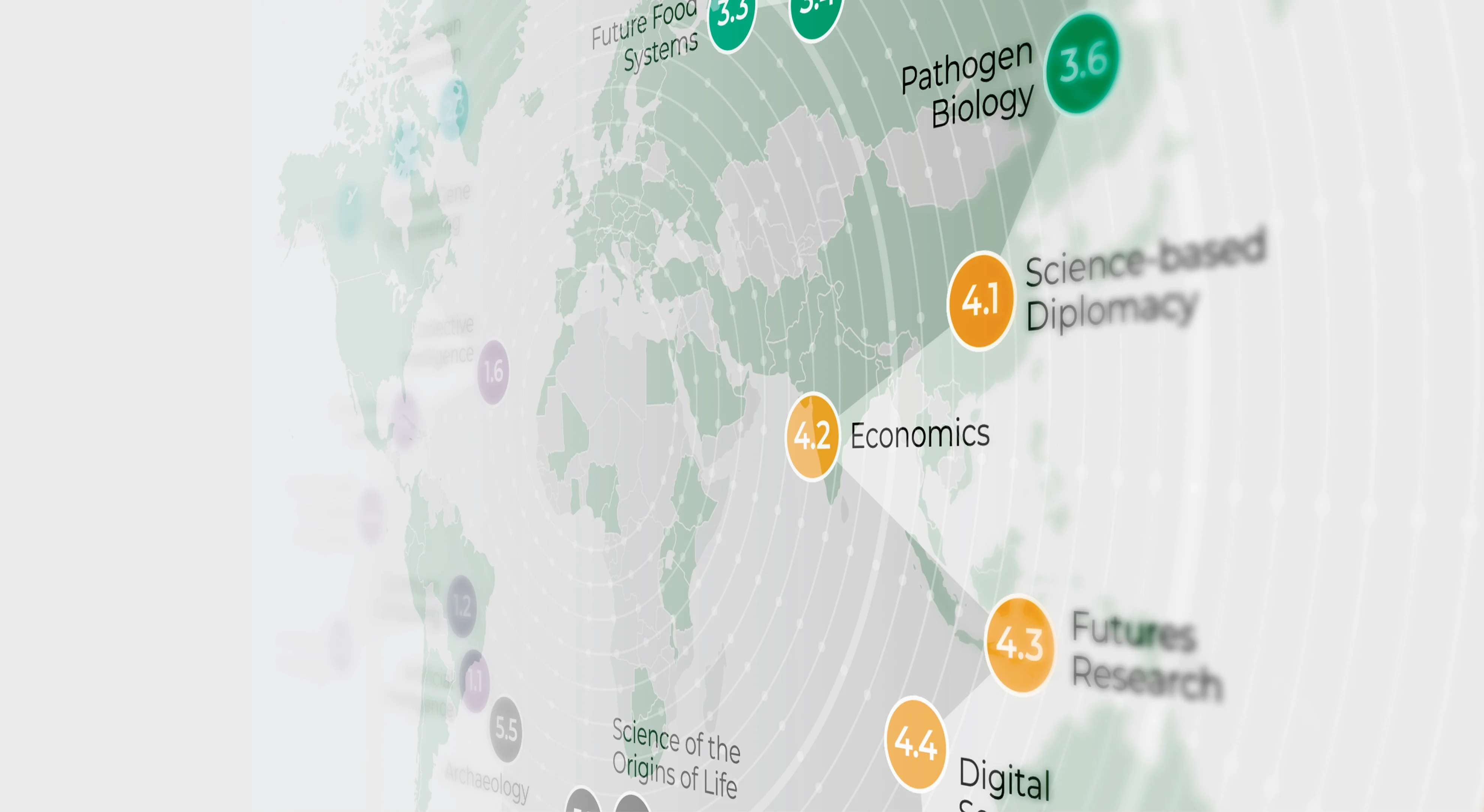
The GESDA Science Breakthrough Radar® is the principal structure through which this intelligence is organised and communicated. It is composed of five themes:
These themes are interdisciplinary by design and permeable: topics often sit across more than one, and the themes are built to absorb new topics as the Radar evolves, adapting to emerging trends in science and research.
Framed by general Theme Introductions, the GESDA Science Breakthrough Radar® features Breakthrough Briefs –one for each dot on the Radar’s graphic – alongside Sense-Maker Briefs, Landmark Reports and Invited Contributions.
Theme development
Three fundamental questions drive GESDA’s science anticipation:
Who are we, as humans? – How will future scientific and technological breakthroughs redefine what it means to be human?
How can we live together, as societies? – What new forms of social organisation and cultural practice will emerge from future scientific and technological breakthroughs?
What is our relationship with the planet? – How do we integrate future scientific and technological breakthroughs at a planetary scale, across life forms and generations?
These correspond to the individual, societal and planetary levels at which anticipated science and technology breakthroughs reshape humanity’s planetarised condition. Since the GESDA Science Breakthrough Radar®’sinception, GESDA has worked with a College of Philosophers to explore what the content of the Radar means in the context of each question. The outcomes of these discussions are available online as Landmark Reports.
Building on this work, each of the Radar’s five themes is philosophy-led and as such is accompanied by a high-level editorial piece, authored by GESDA and drawing on its standing engagement with the philosophy community. Theme Introductions work at the scale of the whole theme, asking what the advances gathered under it mean. Bybringing GESDA’s three questions to bear on its theme, each piece acts not as commentary layered onto the science after the fact, but as a constitutive frame through which the theme’s stakes come into view.
On this basis a Theme Introduction does three things. It makes explicit the assumptions embedded in a theme’s advances, surfacing the points of tension where they unsettle the status quo. It offers frameworks for making sense of those advances across the individual, societal and planetary levels, developing new concepts and reframing established questions where they demand it. And it considers the conditions under which such advances might be taken up.
Throughout, the Theme Introductions act in the spirit of an honest knowledge broker: they neither resolve the questions they raise nor prescribe a course of action, but surface the values and worldviews at stake without adjudicating between them, widening rather than narrowing the range of choices open to citizens, societies and decision-makers.
GESDA Anticipation Workshops
The Anticipation Workshops are the cornerstone of GESDA’s methodology, representing the most regular and established mechanism through which anticipatory intelligence is gathered. These workshops, led by an academic chair, convene leading experts in each field of interest to provide perspectives on anticipated developments in the four individual sub-fields over a 5, 10 and 25-year timeline. The approach is resolutely interdisciplinary and opportunity-driven rather than narrowly risk-focused.
Anticipation Workshops take place online and typically last between two and four hours. During the meeting, the lead discussants for each sub-field are invited by the chair to briefly present their perspectives at the start of each section, before the discussion is opened to all. These presentations, and the discussions that follow, are based on the following questions, which participants receive ahead of the meeting:
What key research opportunities and potential breakthroughs lie ahead in your field?
What theoretical and practical challenges must be overcome for these opportunities or breakthroughs to be realised?
When might these challenges be met, and with what consequences for the field, over the next 5, 10 and 25 years?
Importantly, GESDA is not looking for these discussions to provide a consensus view on the most likely future. Their purpose is to explicitly set out the range of potential futures for a particular field, working from the standpoint of what is known and anticipated by researchers in the current moment. Divergent viewpoints are carried forward rather than reconciled, capturing the full spread of expert anticipation.
The meetings take place in the spirit of the Chatham House Rule, meaning that although participants’ names are disclosed, no quote is attributed to a particular individual, encouraging an open and frank conversation between research peers. GESDA’s team of scientific writers synthesise the outcomes into the Breakthrough Briefs that make up the main body of the Radar. All participants are invited to review and edit these Briefs before final sign-off by the chair for open-access publication on a rolling basis. Once published, these Briefs become the shared basis for GESDA’s ongoing engagement with diplomats and other stakeholders about the opportunities for action they open, including at the GESDA Anticipation Summit, held annually in Geneva, Switzerland.
GESDA Sense-Making Labs
A key challenge for science anticipation is to make anticipatory intelligence about possible scientific and technological futures understandable, relevant and actionable for its stakeholder communities. The Sense-Making Labs address this challenge. Where the Anticipation Workshops establish what may be coming, the Sense-Making Labs interpret what it could mean: by convening domain experts from the social sciences and humanities disciplines most relevant to a given Radar topic, they provide the framework and infrastructure needed to work through the potential implications of those anticipated futures for people, societies and the planet.
The social sciences and humanities enter here as constitutive rather than reactive. The disciplines engaged do not comment on a Radar topic from the outside but reframe it from within, together weaving their perspectives into an anticipatory framework that holds the human, socio-cultural and planetary stakes of an advance in focus as the science and technology develop.
For each Sense-Making Lab, GESDA convenes a small group of leading researchers from relevant disciplines, together with select members of the associated Anticipation Committee, to approach the topic from an anticipatory perspective. The Labs take place online. After a short introduction, each participant presents before the discussion is opened to all, guided by the following questions, which participants receive ahead of the meeting:
What significant human, socio-cultural or planetary transformations and challenges induced by the Radar topic can you anticipate?
Which theoretical or practical resources – concepts, frameworks, methods – could help decision-makersacross communities understand these transformations and address the challenges specific to the topic?
How could implementation pathways be developed to translate this understanding into future-shaping opportunities?
As in the Anticipation Workshops, the purpose is not to reach consensus: differing viewpoints are carried forward rather than reconciled. The meetings again take place in the spirit of the Chatham House Rule, so that no content is attributed to a particular individual, encouraging open and frank exchange between peers.
GESDA’s scientific writers collate the outcomes into a Sense-Maker Brief, which participants review and approve before open-access publication on the Radar platform. Each Sense-Maker Brief is the interpretive counterpart to the topic’s Breakthrough Brief, together forming the qualitative core of the Radar’s coverage.
GESDA High Level Anticipation Meetings
In order to explore broader research areas that transcend individual topics, GESDA convenes each year a small number of interdisciplinary, multiday “GESDA High-Level Anticipation Meetings” both within Switzerland and with partners in diverse international locations. During these meetings, 20 to 30 leading researchers from intersecting fields come together to explore an emerging scientific area based on one or more of the five Radar themes.
Much broader in scope than Anticipation Workshops, GESDA’s Anticipation Meetings are designed to provide a unique space of convergence for leading experts in distinct but related fields. The meetings explore emerging overarching research areas and create corresponding novel conceptual frameworks – crafted for interdisciplinary tractability and strong actionability – within which to anticipate, accelerate and ultimately translate future scientificand technological advances into decision, action and initiatives. Example frameworks from previous meetings include “Eco-augmentation”, defined as “humans’ deliberate and strategic interactions with nature for more resilient and sustainable social-ecological systems”, and “Planetarised Humanity” which captures “changes in the human relational condition that are induced by accelerating socioeconomic and technological co-evolution”.
During the meetings, these overarching concepts are broken down into interconnected sub-themes for in-depth discussion and exploration. The programme typically combines provoking keynote talks with more focused thematic sessions where short presentations frame anticipatory discussions aimed at identifying key developments over 5, 10 and 25-year horizons. While this anticipatory exercise mirrors the work of Anticipation Workshops, by framing these discussions within novel interdisciplinary concepts these meetings serve as a catalyst for field-building and fostering new research communities around emerging concepts. They are also designed to open pathways towardsconcrete action and novel global initiatives.
The output from these meetings takes the form of an open access “Landmark Report”, which is made available through the Radar platform and occasionally issued as a standalone print publication.
Invited Contributions
Invited Contributions capture the perspectives of domain-expert researchers on novel emerging trends not otherwise covered in the Radar, or on complementary areas closely related to existing topics. When a notable area of interest is recognised, the GESDA Science Anticipation Team will invite a leading researcher, or group of researchers, to explore the topic in a shorter essay-style perspective. While these pieces do not carry explicit time horizons such as those found in the Breakthrough Briefs, they trace emerging trajectories and their implications, in keeping with the Radar’s anticipatory outlook. Often maturing into Radar topics in their own right, they represent a key mechanism through which expert insight continues to shape how the Radar’s topics evolve.
Lenses
GESDA’s Science Anticipation Lenses are substantial pieces of novel academic research that build on the insights of the Radar. They provide a transversal perspective across its horizons, examining some of the fundamental questions raised by anticipated breakthroughs within broader scientific, philosophical or geopolitical frameworks. Usuallydeveloped by research groups rather than individual scholars, and in some cases commissioned directly by GESDA, these Lenses are likewise published as open-access “Landmark Reports” on the Radar platform.
Anticipation Potential
GESDA thanks Edouard Machery, Distinguished Professor, University of Pittsburgh, for his contributions in developing the Anticipation Potential metric.
At the foundation of the GESDA Science Breakthrough Radar®’s graphic lies Anticipation Potential: a multi-dimensional metric that captures the potential for impactful action in the present, taking into account the significance of possible future advances in research, science and technology. It is grounded in the perspectives of the research community, gathered each year through a survey of researchers worldwide. The resulting scores, displayed on the Radar graphic, are the quantitative complement to the qualitative Breakthrough and Sense-Maker Briefs, drawn from a far broader sample of researchers than a single workshop convenes.
For each topic, plotted as a dot on the Radar’s radial graph, subject-matter experts are primed with context from the relevant Anticipation Workshop: the four sub-fields it addresses and the significant developments anticipated within each. Respondents then answer a set of neutrally framed questions organised across two dimensions, each resolved into indicators and, beneath them, into the specific proxies actually measured.
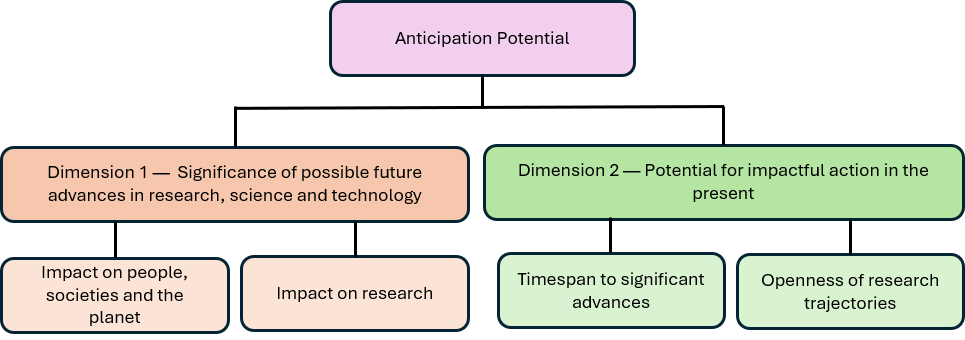
Figure 1. Breakdown of the Anticipation Potential metric
Dimension 1: Significance of possible future advances
The first dimension gauges how significant an advance could be. It works through two equally weighted indicators. The first is the transformative impact on science and research, assessed through four proxies – whether anticipated advances could:
generate methods or findings usable across other disciplines (Crossfield impact)
reshape the field’s own conceptual foundations (Foundational impact)
open entirely new research territories (Generative impact)
bring disparate phenomena under a common explanatory structure (Unifying impact)
The second indicator is the transformative impact on people, societies and the planet, assessed through three proxies, namely, the potential to:
alter human nature and identity (People impact)
reshape how humans organise and live together (Societies impact)
affect humans’ relationship with the planet (Planet impact)
Because the two indicators carry equal weight, impact on research counts for as much as the combined impact on people, societies and the planet – recognising that researchers are best placed to judge research impact, and that science anticipation is centred on developments in science and research.
Dimension 2: Potential for impactful action in the present
The second dimension assesses how much room there is to shape these advances. As with the first dimension, it works through two equally weighted indicators. The first is the timespan of anticipated advances – the horizon within which major advances are expected to materialise, scored from “now” through the 5, 10 and 25-year sequence to “beyond 25 years”. The second is the openness of the research landscape, assessed through three proxies:
whether multiple research trajectories remain genuinely open rather than converging on a single path(directional openness)
whether the field’s theoretical frameworks remain unsettled rather than consolidated around a consensus(paradigmatic openness)
whether its methods and instruments are still expandable rather than approaching their limits (instrumental openness)
A longer timespan and greater openness both raise Anticipation Potential. Accordingly, the metric measures scope for action, not urgency. The two pull in opposite directions on time – urgency rising as the horizon shortens, scope for action as it lengthens – and it is deliberately the latter that Anticipation Potential tracks.
Reading the metric
Scores build from the bottom up by equal averaging at each level: proxies average into their indicator, indicators into their dimension and the two dimensions into a single Anticipation Potential score, with sub-field scores averaging up to the topic. The headline score is the entry point, but through the Radar it is disaggregated into each topic’s four sub-topics.
Together, the Anticipation Potential’s dimensions give a year-on-year, comparable reading of where anticipatory action in the present on possible scientific and technological futures could matter most – how significant an advance may prove, and how much scope remains to shape it before its direction settles.