
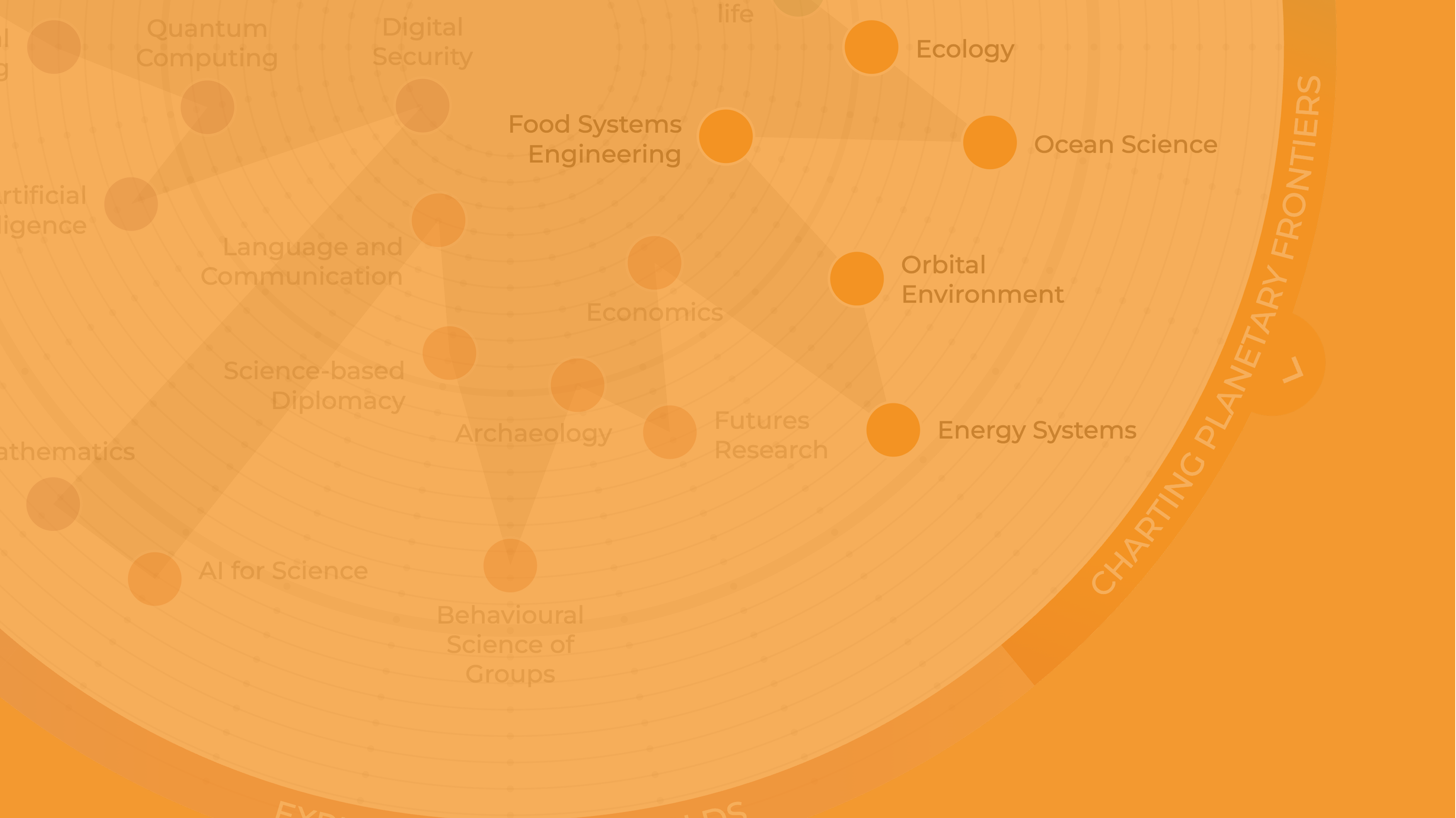
On land, food systems engineering is being remade by gene editing, alternative proteins and new approaches to nutritional security on a warming planet with a growing population. Above us, the orbital environment is becoming increasingly crowded with satellite constellations, and human interests are extending towards the Moon, raising new questions about debris, governance and the long-term sustainability of these new commons. Underwriting these transformations is energy engineering, whose advances in fusion, storage and renewable infrastructure will determine the decarbonisation transition. These developments share a recognition that humanity has acquired transformative power at planetary scale, and now has to think, at that same scale, about what to do with it.
This novel situation is commonly captured by the multifaceted concept of the Anthropocene. Scientifically, this concept acknowledges the quantitative impact humans have on the environment, evident in measurable changes such as global warming and biodiversity loss. Politically and morally, it raises awareness of our role and responsibility in these changes, underscoring the need for mitigation efforts. Philosophically, it challenges us to rethink our relationship with nature, moving beyond dominant human/nature and technology/nature dualisms, towards an understanding of the intricate entanglements between nature, technology and humanity.
Who Are We, as Humans?
As humans in this setting, we are, to varying extents across demographics, technology-powered transformative agents with unprecedented abilities to shape and sustain new social-ecological environments. We are endowed, for better and for worse, with what some have called the position of the Earth’s ultimate ecosystem engineers. But just being aware of our impact is not enough to prompt effective and responsible action. Furthermore, reliance on the belief that technological solutions alone can fix the planetary polycrisis may prove inadequate if not outright hubristic. Against this backdrop, a sharp dilemma arises: should we restrain our transformative nature or harness it?
The same question takes a different form when asked from within the imaginary that drives much of the present. The Anthropocene suggests that the human is bequeathed new forms of agency to transform earth systems and evolution itself (see “Engineering Biological Systems”). However, this transformative power is unevenly distributed: not all humans, in all parts of the world, share equally in it, or in its consequences. It is a new imaginary, and a contested one. In this picture, the hyper-control that technologised humanity has reached is not, in fact, under control. By failing to acknowledge and understand the limitations of human control, humans, however empowered, lose the possibility of exerting control responsibly. A crucial aspect of negotiating technology-powered human-nature interactions on the planetary scale is therefore determining when, where and how to draw the line between humility and hubris, while recognising that what was once considered hubris can become normalised over time.
How can we live together, as societies?
Living together as a planetarised humanity requires strategies for navigating scales, becoming more local and more global at the same time. A planetarised humanity cannot be governed top-down but requires bottom-up organisation at the community level. At the same time, challenges such as climate change, biodiversity loss and ocean acidification are global and require global coordination. Consequently, a transformative perspective for living together needs to be organised across multiple scales, reframing entrenched nation-based perspectives both by scaling down to the local and scaling up to the global. Some of these planetary scales now extend beyond Earth itself, raising similar questions about commons, governance and responsibility in orbital space.
The same multi-scalar logic operates within ecology itself. A methodological frame has emerged for thinking about humans and ecosystems together rather than separately. In the coupled dynamics of human societies and ecosystems treated as complex adaptive systems, evolutionary, ecological and sociocultural processes interplay through reciprocal adaptation and feedback. Within this frame, the dynamics of human-nature co-evolution can be captured across three interconnected dimensions: how human activity shapes ecosystems and is shaped by them in return, how these effects are transmitted across generations, and how distant social-ecological niches influence one another globally. These three dimensions highlight ethical considerations of interspecies, intergenerational and intragenerational justice, respectively. Congruent with such an approach is the recognition of Indigenous, local and traditional ecological knowledge systems. These cumulative bodies of practice and belief, anchored in direct historical experiences of disturbance and transmitted culturally across generations, provide resilience-driven ecosystem management that complements adaptive management strategies. When reconciled with scientific knowledge across their cultural, ontological and linguistic variations, they will help translate environmental research into effective governance.
What is our relationship with the planet?
The planetary question itself, for this theme, requires the sharpest attention. We cannot innovate our way into a sustainable future if we do not fundamentally rethink our relationship with nature. Sustainability discourses are everywhere – from the Sustainable Development Goals to corporate responsibility frameworks – and yet planetary crises such as climate change and biodiversity loss continue to unfold at a rapid pace with dramatic and unmitigated socio-economic consequences. The status quo of sustainability discourses has become part of the problem rather than the solution. Sustainability itself is in fact not a neutral label. It emerged from a deeply modern discourse that primarily relates to nature as a resource system, and one that can be depleted when extraction exceeds their self-regenerative capacities. While sustainability discourses remind us of the need for careful resource management of fisheries, forests, freshwater, or fossil reserves, they do not tell us how to avoid resource depletion in a modern economy predicated on the promise of indefinite economic growth.
Paradoxically, a sustainable future may therefore require us to move beyond the very notion of sustainability. Indigenous communities are often called sustainable, but their understanding of nature has little to do with modern ideas of managing depletable resource systems. In Indigenous knowledge systems, non-destructive relations with nature are not driven by instrumental management demands but by norms of respectful engagement based on reciprocity, interdependency and mutual commitments through kinship relations with rivers, mountains, forests and the beings that inhabit them. These knowledge systems provide powerful lessons about the possibility of building different relations with nature, employing mutual learning rather than simple transfer. A sustainable future requires that we relearn how to relate to nature as more than a resource system, and that we develop novel ways of co-creating mutually beneficial co-existence. Ensuring such a future entails re-imagining our economy: how we produce value; for what and for whom; how we build infrastructure, use energy, construct technology and to what ends. Sustainability, thus framed, must define a process and a potential, not an existing state, and must be about sustaining life’s possibilities, not conserving the present.
The convergence point is what might be called multispecies sustainability: valuing relationality with the environment and interconnectedness across life forms; meeting the interdependent needs of all species; and viewing non-humans not as resources but as actors with agency, whose interests must be negotiated to ensure the well-being of both current and future generations across the spectrum of life forms. Charting the planetary futures named by this theme, then, means accepting that we are part of a larger web of life, and that the science- and technology-powered transformations described here must be governed by what we are willing to sustain, and for whom.
Associated Topics:

Topic
Ecology

Topic
Ocean Science

Topic
Food Systems Engineering

Topic
Orbital Environment