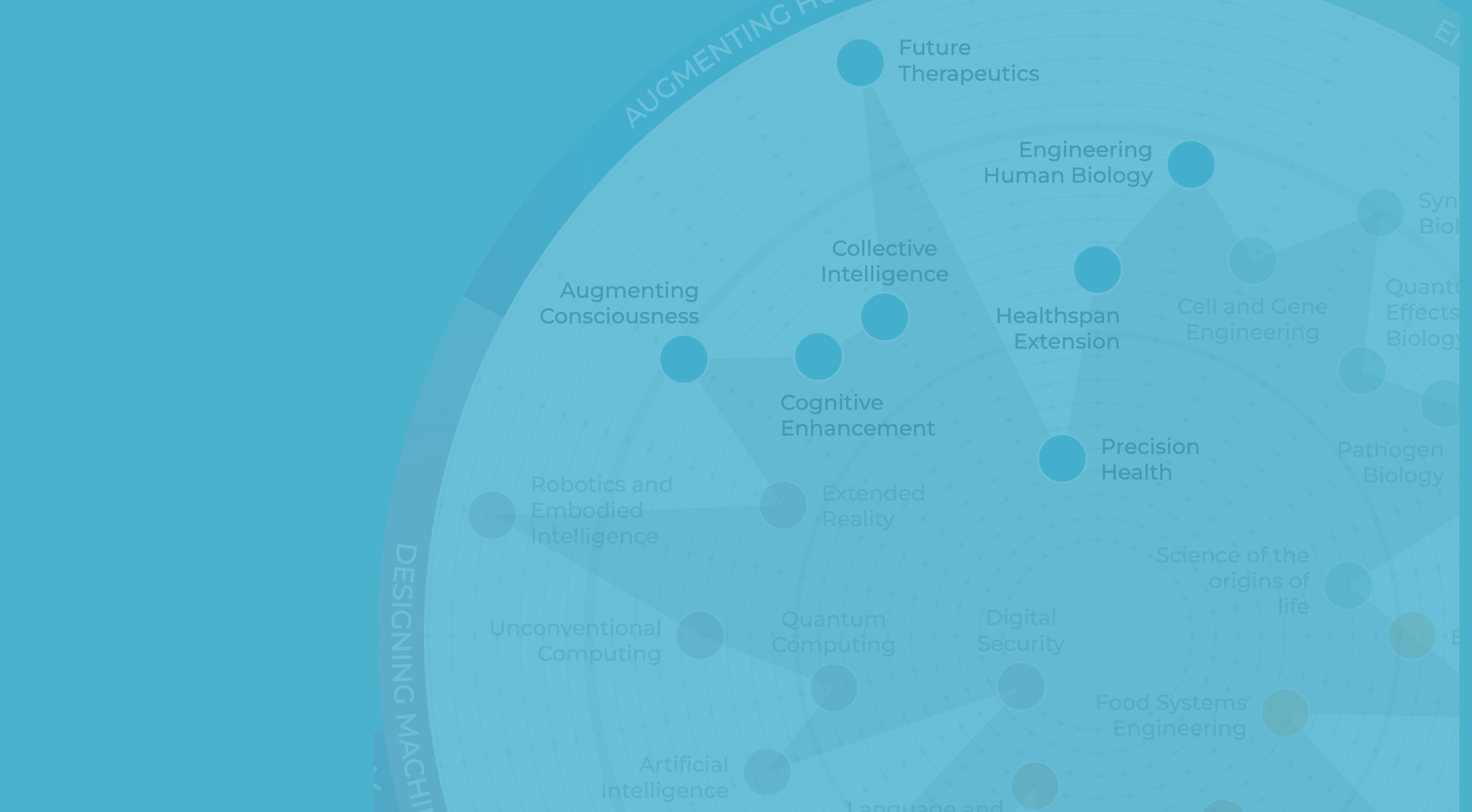
Collective intelligence then brings these capacities into the social fabric, where the architecture of groups, increasingly populated by artificial agents, determines what collectives can think and do. Precision health turns the human body into a domain of high-resolution data, integrating genomics, multi-omics and continuous physiological measurement to move medicine from treatment towards anticipation and prevention. Future therapeutics builds on this with gene therapies, advanced biologics and new modalities of intervention that transform what it means to treat disease, navigating the blurry and shifting line between therapy and enhancement. Healthspan extension pushes further, targeting not only the duration but the quality of life through advances in cellular reprogramming and the biology of ageing. The engineering of human biology operates at the deepest level, reshaping development, reproduction and the molecular architecture of the body – even moving human biological material beyond its bodily boundaries.
Who are we, as humans?
The developments in this theme share a recognition that the human is no longer a fixed reference point but a domain of active design. While doing so, they touch two core aspects of who we are as humans, our minds and our bodies, compelling us to rethink what we have taken to be typical of us, and what is central to how we individuate ourselves. This includes rationality, intelligence, consciousness, autonomy, agency (whether moral, epistemic or other) and identity. All these dimensions are value-laden; all come with a normative bearing that tends to crystallise into ideals endowed with a standardising power, such as ableism, sanism and ageism in the case of health-related values connected to augmentation.
The pressure on these dimensions is twofold. From one side, they no longer pick out what they once did. Rational intelligence, for example, has long been viewed as distinctively human and was implicitly paired with other typically human properties such as consciousness and understanding. However, non-conscious machines lacking any understanding can now outperform human rational intelligence at sophisticated problem-solving tasks (see “Designing Machine Realities”). From the other side, augmentation itself reshapes the bearers of the properties. As our cognitive and bodily capacities become ever more technologically mediated and recomposed, the question is no longer only what a person, an agent or a conscious being is, but who and how we are when we exercise these capacities through artificially designed interfaces that continuously interfere with our individual condition.
At this individual level, a particular imaginary pulls augmentation in a specific direction. The ideal of exceeding or evading the limits of biological systems and cognition through technology – with technology now ordained as commanding evolution itself – has become a powerful organising fantasy. But this notion of a superhuman linked to superintelligence is not a category assigned to all humans in all geographies; it is a new imaginary of what the human might be, an imaginary that sees the future of science and technology as a pre-determined force rather than emergent choices. What this imaginary precludes is that technology, properly understood, can augment and assist us in becoming more humane, without ever replacing us in any meaningful sense, since we are, and have always been, technological beings intrinsically.
A central question for augmentation is therefore whether we want to preserve certain properties, or a combination thereof, as the sole remit of human beings, and if so, which, in which contexts and for which tasks. A possible way forward to avoid the pitfalls of human exceptionalism is to make room for a non-anthropocentric variety of these basic concepts – concepts no longer tied to supposedly unique human traits but defined by performing differently at different tasks and in different contexts. We might have artificial creativity alongside human creativity without treating the latter as genuine while deeming the former counterfeit by default. We might create distinct spaces for human-artificial collaboration in decision-making, emotion or problem-solving without side-stepping the question of when human involvement should be prioritised. Avoiding discrimination against non-human agents with which we may lack kinship relations will remain a contentious point that similarly extends to natural and artificial entities.
How can we live together, as societies?
Augmentation also returns the social question with new force. Cognitive enhancement technologies will make it more obvious that human cognition is, and has always been, an extended, distributed and collective activity, socially embedded and heavily reliant on external technological devices (see “Exploring Social Worlds”). In this picture, the collective level is not derivative of the individual; it precedes and constitutes it. The Collective Intelligence topic in this theme makes the same point empirically, in a different register: cognitive performance scales not with individual capacity but with the architecture of the group, and the groups in question increasingly include non-human participants. The relational dimension of our human condition – our being human through others, our political animal condition, our relational self – is amplified by augmentation, not bypassed by it. And a key consideration will be whether the basic concepts we use to define who we are, as individual humans within a planetarised humanity, can be equally bestowed and accessible among individuals while striving to preserve a diversity of norms and ideals across cultures. If not, the standardising power crystallising in them may simply re-export existing exclusions in augmented form.
What is our relationship with the planet?
The planetary dimension of human augmentation is the one most easily missed. It should not be: the human is now bequeathed new forms of agency to transform earth systems and evolution itself (see “Charting Planetary Frontiers”). The augmentation of superhuman ideals is one expression of that agency, and the imaginary of unbounded enhancement is continuous with the imaginary of unbounded earth engineering: both rest on the same denial of limits, the same assumption that technology will simply continue to deliver what biology cannot. To counter this would be to treat technology not as a replacement for the human, where some will make it through the transition while others will not, but again, as augmenting and assisting all of us to become more humane. Augmenting human potential, so construed, is justified to the extent that it enlarges the space of who and how we may yet become.
A final observation crosses all three levels: human augmentation will radically transform individual human lives, not any putative human nature, whatever that might be. In other words, the emerging science and technologies from this theme might merely make more salient and pressing implicit aspects of our humanity that were always present but never so consequential – aspects such as distribution, dependence, relationality and vulnerability. The work of augmentation, properly understood, is not to overcome these aspects but to design within them at a planetary scale.
Associated Topics:
Topic
Augmenting Consciousness
Topic
Cognitive Enhancement

Topic
Collective Intelligence
Topic
Future Therapeutics
Topic
Precision Health
Topic
Healthspan Extension