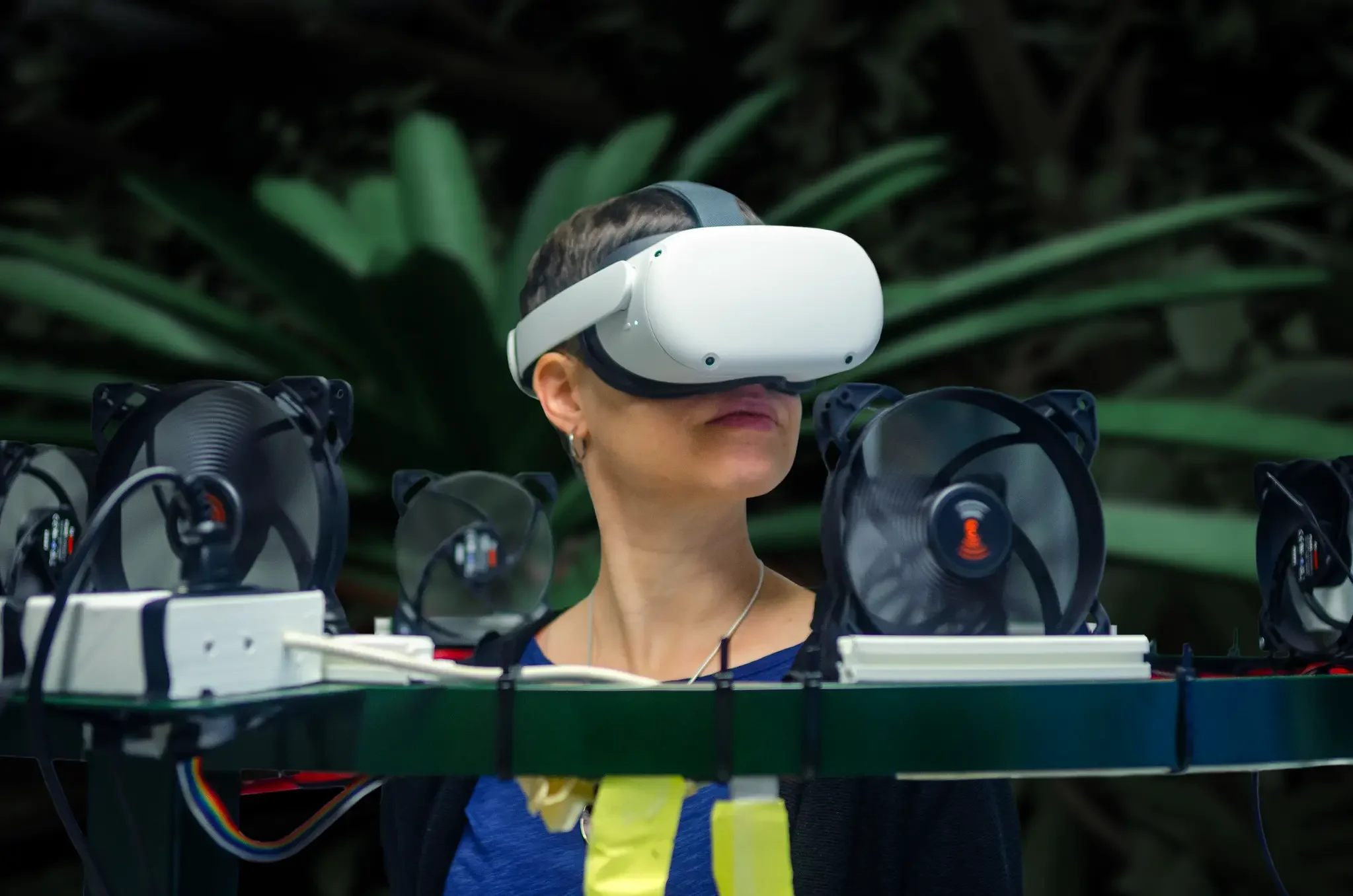
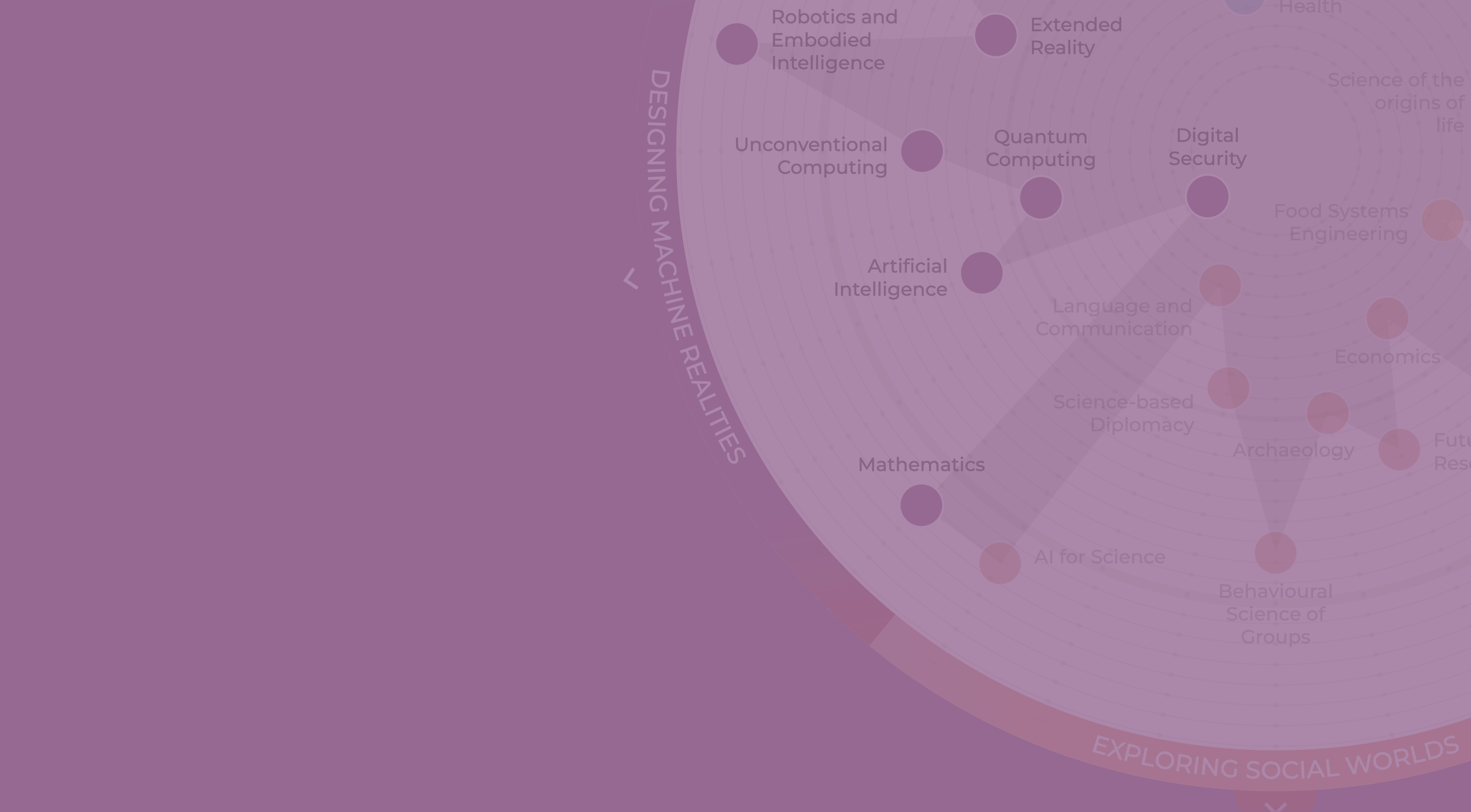
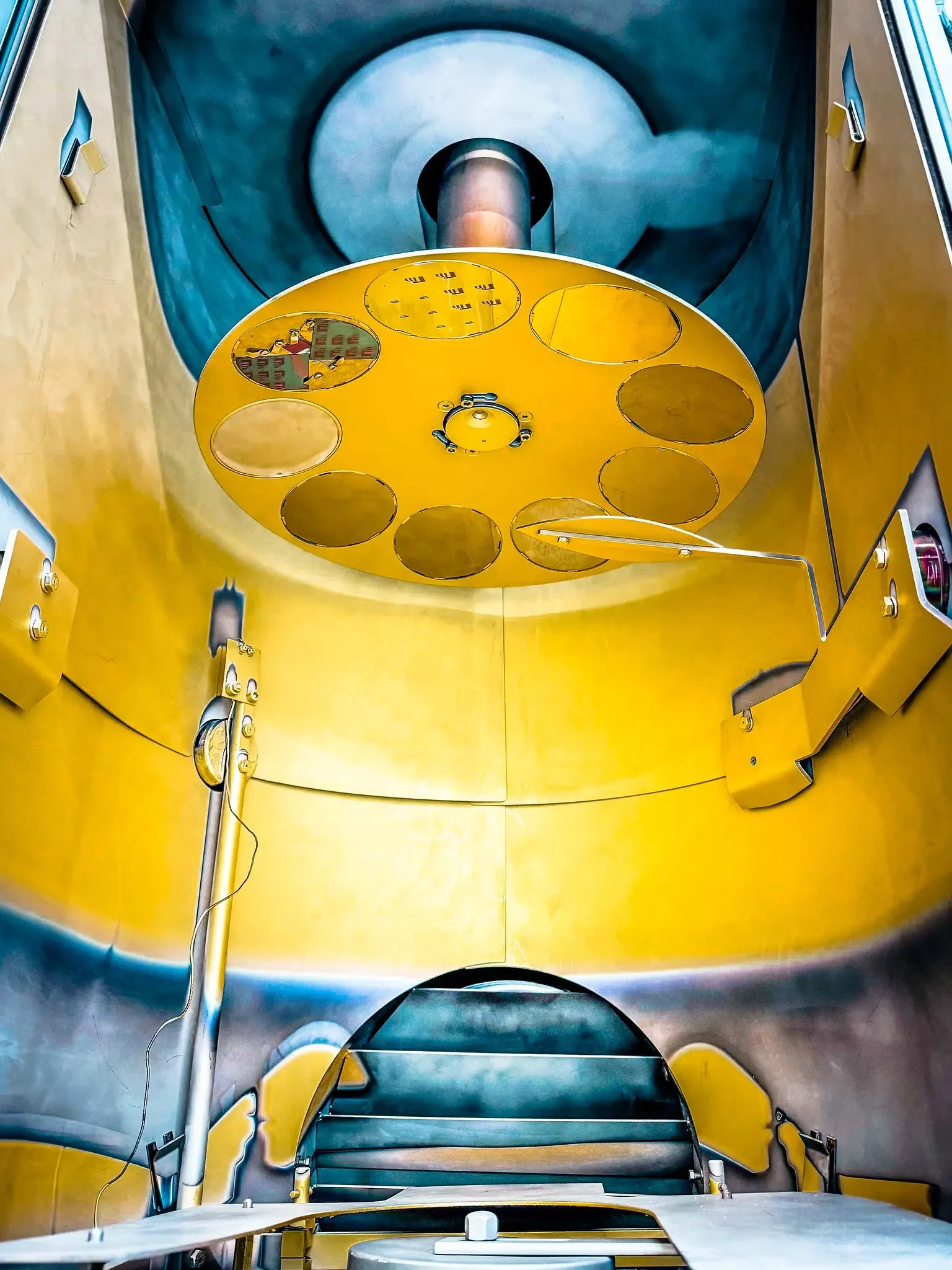
Quantum computing reaches deep into the physical substrate of computation, exploiting properties of fundamental matter that classical machines cannot access. Unconventional computing pushes the substrate question in a different direction, extending computation into biological, chemical and physical media beyond silicon. Robotics and embodied intelligence give these computational capacities a body, situating the computation within the material constraints of action and perception and giving it the opportunity to interact with the physical world. Digital security supplies the trust infrastructure through which the resulting assemblies of human and artificial agents can safely and reliably communicate, exchange and verify at scale. Extended reality, finally, engineers the perceptual interfaces through which these environments become inhabitable by human (and perhaps other) minds.
Together, the topics gathered here make a single underlying gesture: the deliberate engineering of new agents alongside the substrates and interfaces through which we interact with them. What is being designed is therefore not merely a set of tools but a redistribution of agency. From this perspective, designing machine realities critically involves engineering the material and formal grounds for what counts as real when the common category of the agent itself is no longer restricted to human or natural beings.
Who are we, as humans?
When we focus on the human individual, this redistribution challenges the central tenet of modern political and moral thinking. The sovereign individual, taken for three centuries as the basic unit of moral, legal and political reasoning, was a profoundly consequential abstraction. It animated many of humanity’s greatest achievements in statecraft and democracy, as well as many of its worst horrors in genocidal killing, labour abuse and colonial extraction. Its original question was: who counts as one of us, and on what grounds is the designation granted or denied? Designing machine realities does not solve this question; it transforms it. A newer set of questions arises that are different in kind: what is a machine when it can imperceptibly imitate a human? And what is a human who comes to mimic the machines? These are not questions about simply extending the category of the agent to new candidates. They register that “human” and “machine” are not stable entities but relational ones, constantly evolving with environment, society and culture, and that the boundary between them is something the designs at issue here actively reshape.
At this conceptual level, this transformation percolates through the vocabulary by which we have understood ourselves. Person, rationality, freedom, consciousness, responsibility: all of these notions were calibrated to a category of agent whose features we took to be distinctive. Specifically, rational intelligence in the Western tradition has long been viewed as distinctively human and was implicitly paired with consciousness and understanding. But non-conscious machines lacking any understanding can now outperform human rational intelligence at sophisticated problem-solving tasks, prompting humans to acquire new heuristics by learning from the machines. This calls for a fundamental rethink of our very concept of rationality and what makes it so supposedly distinctive. The large-scale offloading or delegation of non-basic human cognitive abilities to technologies will only increase this need (see “Augmenting Human Potential”). And the concepts under pressure are not neutral: they come with a normative bearing that crystallises into ideals endowed with a standardising power, like the overarching concept of a human itself, whose granting or denial has long influenced our social structures (see “Exploring Social Worlds”).
How can we live together, as societies?
At the social level, therefore, designing machine realities is never the design of objects alone. It is instead the design of the conditions under which humans and machines learn to know, interact and cohabit with each other. At the start of the cybernetic revolution, the question raised was what it means to learn. The answer was that learning is not merely the acquisition of rules but a social and institutional practice shaped by histories, ideologies, aesthetics and institutions. The myth of technocratic solutions to all global challenges, social and political included, obscures precisely this. Quite tellingly, there is no discussion of artificial general intelligence that includes the question of where and how one learns, or that understands learning beyond the ability to adapt to change in an existing condition. Likewise, there was originally no concept of smartness that included the ability to envision alternative political futures and technological imaginaries. The discourse of smartness has now merged technical and biological determinism, reducing the language of education to that of adaptation and evolution. By contrast, in the cybernetic spirit, living together with these technologies means thinking of technology not as a solution to politics but as itself political. The technologised cities of the future would then not be those that automate the social, but those that seek to responsibly experiment with the political and consciously reflect upon it.
What is our relationship with the planet?
Because we are now designing machine realities, the relationship between humans and the technologies we design is no longer one between a subject and the objects it manipulates. The centred human subject is giving way to multi-agent assemblies whose constitutive units are heterogeneous – human, artificial, environmental – without one occupying the privileged position at the centre. In this movement beyond centric thinking, all agents become mediators within complex networks of interdependent relationships, both synchronically and diachronically. The technical powers designed here to model, understand and evaluate planetary systems at new scales and temporalities can be used in new ways: not to continue the past, but to invent futures. Planetary sustainability is itself a project of redesigning the relationship between humans and the planetary systems they now act upon (see “Charting Planetary Frontiers”). And so designing machine realities therefore involves determining how humans and the worlds they design come to form sustainable systems, and on what terms these emerging configurations can evolve.
Associated Topics:

Topic
Mathematics

Topic
Digital Security
Topic
Artificial Intelligence
Topic
Quantum Computing

Topic
Unconventional Computing

Topic
Robotics and Embodied Intelligence