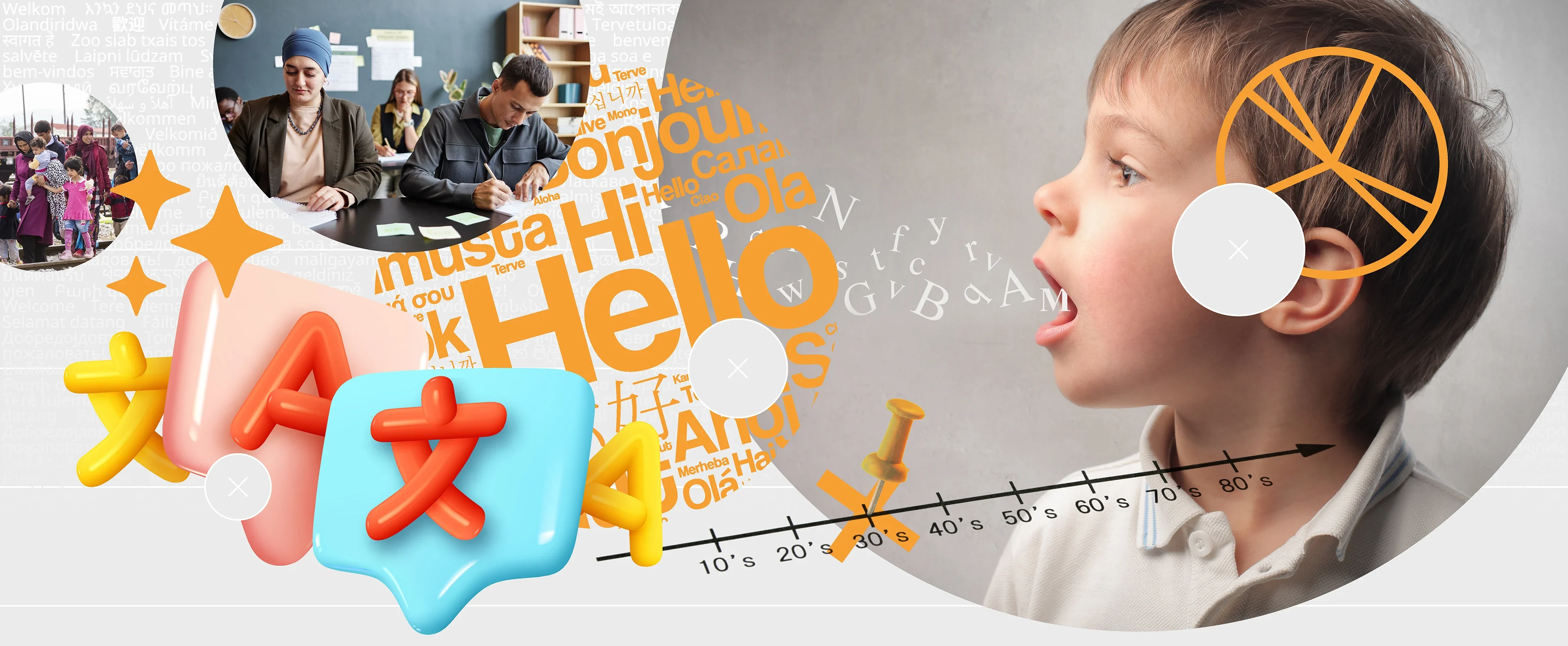
Speaking two or more languages is commonplace and has probably been the norm for much of human existence.42 In contrast, monolingualism is a relatively rare state. The regulation of languages, with impacts on multilingualism, is tied to state actions including oppression and persecution.43 Negative attitudes and misinformation around multilingualism44 continue to result in languages being marginalised and in some cases lost. There is evidence that enforced language (dis-)use causes concrete harm, preventing people who are less than fluent in an approved language from accessing education and other essential services.45 By contrast, we now know that multilingualism does not interfere with children’s language acquisition,46 can facilitate learning additional languages,47 increases connections between people and their culture,48 and may have positive impacts on other cognitive capacities, such as perspective-taking and executive function.49,50
Research clearly documents the positive impacts of multilingual education policies that encourage and maintain the use of students’ mother tongue in both primary and secondary schools.54 A key challenge is to understand how people learn multiple languages, and thus improve language-learning outcomes, particularly in adults. There is ongoing debate about whether there is a “sensitive period” after which language learning becomes substantially impaired.58 However, recent evidence suggests that native-like outcomes are possible even up to adulthood.59 Notably, the empirical data on second-language acquisition involves an over-representation of English, and more reliable methods of measuring vocabulary and grammatical knowledge in multilingual children and adults
are needed.60 The limits of adult language-learning abilities across diverse settings remain poorly understood. Likewise, it is crucial to better understand how learning a second language affects the first one, a process commonly called “attrition”, which can nevertheless be seen as a normal change due to language contact.61 There is also an emerging field exploring how multilingualism interacts with neurodivergence.62 Importantly, researchers are now developing new metrics of multilingualism.63 These seek to capture more nuance in people’s ability to communicate across language barriers: for instance, measuring subtle gradations in fluency.64